Suffix (Basic ㊦ 384)
A suffix (originally meaning 'appearance') that indicates the speaker's/writer's politeness towards someone.
Equivalent: Mr; Miss; Ms; Mrs
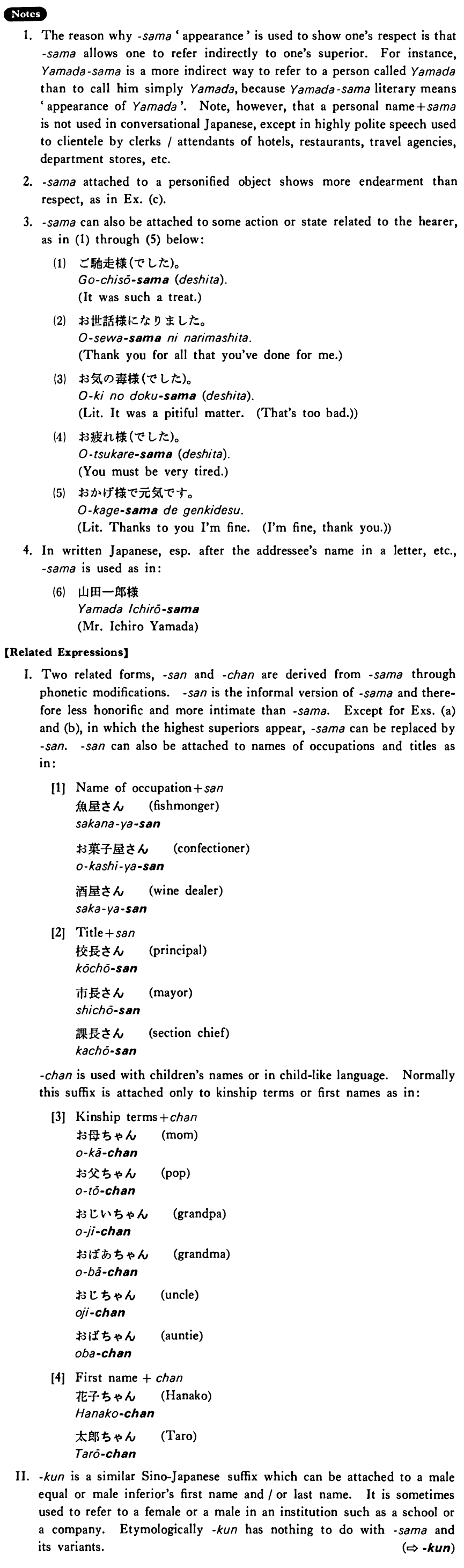
1. The reason why 様 'appearance' is used to show one's respect is that 様 allows one to refer indirectly to one's superior. For instance, 山田様 is a more indirect way to refer to a person called 山田 than to call him simply 山田, because 山田様 literary means 'appearance of 山田'. Note, however, that a personal name+様 is not used in conversational Japanese, except in highly polite speech used to clientele by clerks/attendants of hotels, restaurants, travel agencies, department stores, etc.
2. 様 attached to a personified object shows more endearment than respect, as in Example (c).
3. 様 can also be attached to some action or state related to the hearer, as in (1) through (5) below:
4. In written Japanese, especially after the addressee's name in a letter, etc., 様 is used as in:
【Related Expressions】
I. Two related forms, さん and ちゃん are derived from 様 through phonetic modifications. さん is the informal version of 様 and therefore less honorific and more intimate than 様. Except for Examples (a) and (b), in which the highest superiors appear, 様 can be replaced by さん. さん can also be attached to names of occupations and titles as in:
[1] Name of occupation+さん
[2] Title+さん
ちゃん is used with children's names or in child-like language. Normally this suffix is attached only to kinship terms or first names as in:
[3] Kinship terms+ちゃん
[4] First name+ちゃん
II. 君 is a similar Sino-Japanese suffix which can be attached to a male equal or male inferior's first name and/or last name. It is sometimes used to refer to a female or a male in an institution such as a school or a company. Etymologically 君 has nothing to do with 様 and its variants.
(⇨ 君)